Whether you're considering a complete solar system for your home or a portable power station for outdoor use, it's essential to understand technical specifications and know how to interpret them correctly.
Especially with very low-priced devices, manufacturers often advertise impressive-looking numbers that can be misleading at first glance.
At the same time, important specifications relating to actual operating performance, usable power output, and battery storage capacity are often difficult to find or are not explained clearly enough.
But what do these technical specifications really mean? How much energy can a device actually store? Which appliances can it power? And what should you look for when buying to avoid making the wrong decision?
To help you compare products more effectively and make the right purchasing decision, here is a short, easy-to-understand overview of the most important technical specifications – and what really matters in everyday use.
Watts (W): How Much Power Can the Device Deliver at Once?
With low-cost power stations, manufacturers often emphasize the wattage (W) rather than the actual battery storage capacity (Wh). This can create the misleading impression that the device has a large battery or can provide power for a long time.
Don't be fooled by big numbers! A power station rated at 1,000 W does not necessarily have a large battery. It may deliver 1,000 W of output power while having only a small amount of stored energy.
Always check the battery capacity in Wh (watt-hours) or kWh (kilowatt-hours) before buying. This is the key specification that tells you how much energy the battery can store.
Continuous Power vs. Peak Power: Which Appliances Can You Start and Run Reliably?
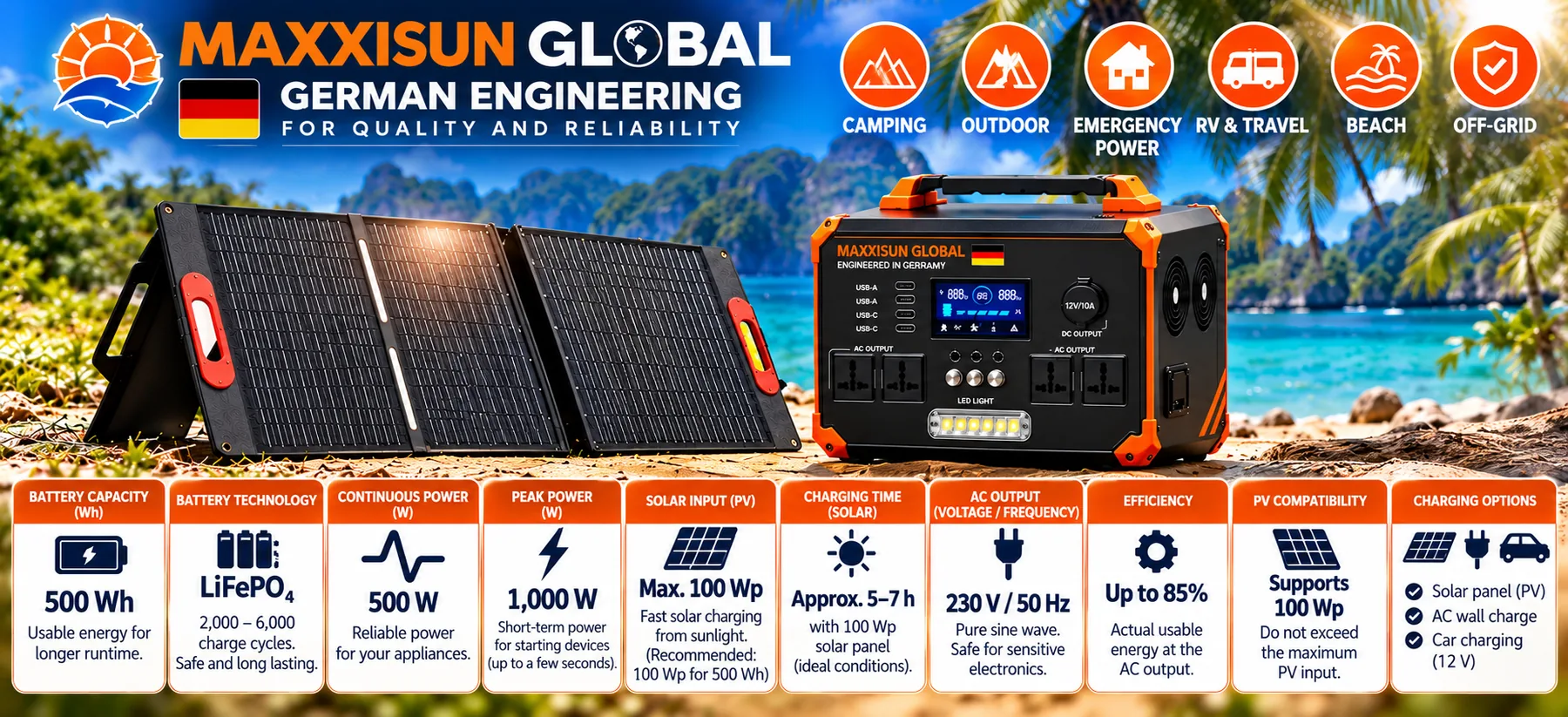
Continuous power is the amount of power a power station or inverter can deliver continuously during normal operation. Peak power is the maximum power the device can deliver for a short period, often just a few seconds.
This additional power is particularly important when starting appliances with electric motors or compressors, such as refrigerators, water pumps, and air conditioners, which may require significantly more power to start than to keep running.
Example: Continuous power: 1,000 W. Peak power: 2,000 W for a short period.
This means the device can supply 1,000 W continuously, while it may briefly provide up to 2,000 W to handle a starting surge, provided the manufacturer's specifications allow it.
Solar Input (Wp): How Much Solar Power Can the Panels Generate?
The watt-peak rating (Wp) indicates the maximum power a solar panel can produce under standard test conditions. For example, a 100 Wp solar panel can deliver up to 100 watts under ideal conditions.
Important: Check the maximum solar charging input of your power station! Many low-cost power stations have a very limited solar input, sometimes only 20 W or 40 W. Even if you connect a more powerful solar panel, the power station cannot accept more than its specified maximum input.
Example: A 500 Wh power station with a maximum solar input of 40 W
- Battery capacity: 500 Wh
- Maximum solar input: 40 W
- Solar panel: 100 Wp
Charging a completely empty 500 Wh battery at a constant 40 W would take at least 12.5 hours. In practice, it takes longer because of changing sunlight, conversion losses, and the battery's charging characteristics.
Battery Technology and Lifespan: How Many Charge Cycles Can You Realistically Expect?
Not all batteries are created equal. The battery technology used in a power station has a major impact on its lifespan, safety, performance, and long-term operating costs. The two most common battery technologies in portable power stations are:
LiFePO₄ (Lithium Iron Phosphate)
- Typical lifespan: approximately 3,000–6,000 charge cycles, depending on battery quality and operating conditions.
- Longer service life and generally better thermal stability.
- The better choice for frequent use and long-term investment.
NMC (Lithium Nickel Manganese Cobalt Oxide)
- Typical lifespan: approximately 500–1,500 charge cycles, depending on cell quality and operating conditions.
- Often offers a high energy density, allowing for a lighter and more compact design.
- Commonly found in smaller or lower-cost portable power stations.
Inverter and Output Voltage: Which Appliances Can You Connect Safely?
The inverter converts the battery's DC power into AC power, allowing you to operate household appliances such as refrigerators, televisions, computers, and air conditioners.
However, not every power station or solar inverter is suitable for every appliance. Before buying, check the following specifications:
Output frequency (Hz)
The frequency must be compatible with the connected equipment.
- 60 Hz: Used in the Philippines and North America.
- 50 Hz: Used in South Africa and most European countries.
Pure sine wave vs. modified sine wave
The waveform produced by the inverter is another important factor.
- Pure sine wave: Produces a smooth AC waveform similar to normal utility power. Recommended for sensitive electronics, refrigerators, pumps, and most household appliances.
- Modified sine wave: Produces a less smooth waveform and may cause some appliances to run noisily, inefficiently, or not at all.
For a reliable solar system or portable power station, a pure sine wave inverter is the better choice.
Efficiency and Usable Capacity: How Much of the Stored Energy Actually Reaches Your Appliances?
The battery capacity advertised by a manufacturer does not necessarily equal the amount of energy you can actually use to power your appliances. Energy is lost during the conversion from battery DC power to AC power, as well as through the power station's internal electronics and other components.
The inverter's efficiency and the device's own power consumption both affect how much energy is available to your appliances.
Example: A 500 Wh power station
- Advertised battery capacity: 500 Wh
- Assumed overall efficiency: 85%
- Approximate energy available to AC appliances: 425 Wh
This means that although the battery stores 500 Wh, only around 425 Wh may reach your appliances under these assumptions.
If your laptop consumes 80 W, a usable energy supply of 425 Wh would theoretically power it for approximately 5.3 hours. Calculation: 425 Wh ÷ 80 W = 5.3 hours.